
India has taken an important step towards expanding alternative fuels in the automobile sector, with the Ministry of Road Transport and Highways (MoRTH) amending the Central Motor Vehicles Rules, 1989, to formally recognise vehicles capable of running on E85 and E100 fuel. The regulatory change creates a clearer pathway for automakers to introduce flex-fuel vehicles that use high proportions of ethanol instead of conventional petrol.
The development is significant as India seeks to reduce its dependence on imported crude oil, encourage domestic ethanol production and explore alternative energy sources for transportation. However, the approval does not mean that every petrol car currently on Indian roads can use these fuels.
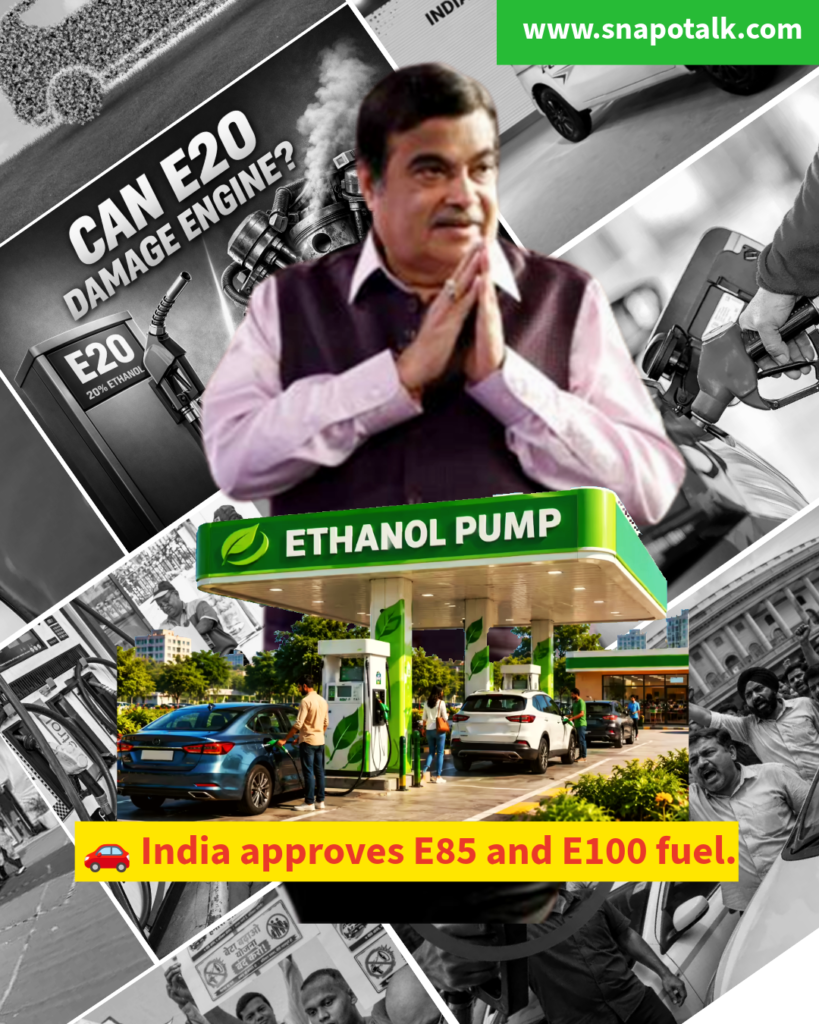
What Are E85 and E100 Fuels?
E85 is a high-ethanol fuel containing approximately 85 per cent ethanol and 15 per cent petrol. E100 refers to fuel consisting almost entirely of ethanol. Ethanol is an alcohol-based fuel that can be produced from agricultural feedstocks such as sugarcane and other biomass materials. Unlike conventional petrol vehicles, flex-fuel vehicles are engineered to operate on different proportions of ethanol and petrol, depending on their design and certification. Their fuel systems, engine components and electronic controls are adapted to handle the approved fuel blends.
The latest regulatory amendment incorporates E100 alongside E85 in the relevant vehicle emission and testing provisions. This gives manufacturers a formal framework for developing and certifying vehicles capable of operating on these higher ethanol.
Government Amends Motor Vehicle Rules
The Ministry of Road Transport and Highways has updated provisions under the Central Motor Vehicles Rules, 1989, to accommodate flex-fuel vehicles designed for E85 and E100. The changes cover emission-related requirements, technical references and testing provisions. The amendment follows an earlier draft proposal that invited public objections and suggestions. By finalising the changes, the government has strengthened the regulatory framework for vehicles that can use high-ethanol fuels. The move could encourage automobile manufacturers to invest further in flex-fuel technology and prepare models designed to operate on a broader range of fuel blends. It also aligns with India’s longer-term efforts to diversify its transport energy sources and increase the use of domestically produced biofuels.
Can Existing Petrol Cars Use E85 or E100?
One of the biggest questions for Indian motorists is whether their existing petrol cars can switch to these fuels. The answer is no, unless the vehicle has been specifically designed and certified for the relevant fuel.
The government has clarified that vehicles designed for conventional petrol or E20 petrol cannot automatically use E85 or E100. E20 contains 20 per cent ethanol, whereas E85 and E100 require vehicles with suitable fuel-system components and engine technology. The new rules do not require existing vehicle owners to modify their cars or switch to higher ethanol blends. Motorists should check their vehicle’s fuel-compatibility label and manufacturer’s instructions before choosing a fuel. Using an incompatible blend could damage vehicle components or affect performance.
Benefits for India’s Economy and Environment
- Reduced dependence on imported oil: Greater domestic ethanol use in suitable vehicles could help reduce petrol consumption and exposure to international crude oil price fluctuations.
- Support for farmers: Increased demand for ethanol may create additional opportunities for agricultural producers and biofuel manufacturers, depending on feedstock availability and procurement policies.
- Potential environmental benefits: Ethanol can reduce certain exhaust pollutants in appropriately designed engines. However, the overall greenhouse gas benefit depends on how the ethanol is produced, transported and used.
- New opportunities for automobile manufacturers: The revised rules give manufacturers a clearer regulatory pathway to develop and certify vehicles capable of running on higher ethanol blends.
Will E85 and E100 Be Available Everywhere?
Regulatory approval for compatible vehicles does not automatically mean E85 and E100 will be available at every petrol pump. Their wider adoption will depend on the expansion of retail fuel outlets, supply chains, vehicle production and consumer demand. India has already begun introducing E85 at selected public-sector oil marketing company outlets. The government announced an initial rollout across 48 outlets in June 2026, with plans to expand access.
What Happens Next?
The amendment marks a notable development in India’s alternative-fuel policy, but the real impact will depend on how quickly manufacturers introduce compatible vehicles and how widely the necessary fuels become available.
For consumers, the key message is simple: E85 and E100 offer new possibilities for specially engineered vehicles, not an immediate replacement for petrol in every existing car. Future adoption will depend on affordability, fuel economy, reliable servicing and the availability of compatible vehicles. If these conditions are met, flex-fuel technology could become an additional part of India’s strategy to diversify transport fuels and reduce its reliance on imported petroleum.