
New Delhi: The celebrations of Diwali may have ended, but their pollution aftermath
has left Delhi-NCR struggling to breathe. Just hours after widespread firecracker
celebrations, the national capital woke up under a thick blanket of grey smog, with air
pollution reaching alarming levels across several neighbourhoods. The situation has
once again raised serious questions about pollution control measures, firecracker
restrictions and the government’s ability to protect public health.
On November 9, the morning after Diwali, Delhi’s overall Air Quality Index (AQI) was
reported at approximately 370–371 by the Central Pollution Control Board (CPCB),
placing the city in the ‘Very Poor’ category. Several monitoring stations, however,
recorded readings above 400, entering the ‘Severe’ category. According to reports,
Delhi Technological University (DTU) and Burari Crossing recorded AQI readings of
437 each.
The situation is particularly concerning because the national capital was already
experiencing unhealthy air quality before Diwali. Firecracker emissions added another
layer of pollution to an atmosphere already affected by vehicle exhaust, industrial
emissions, construction dust and seasonal agricultural burning.
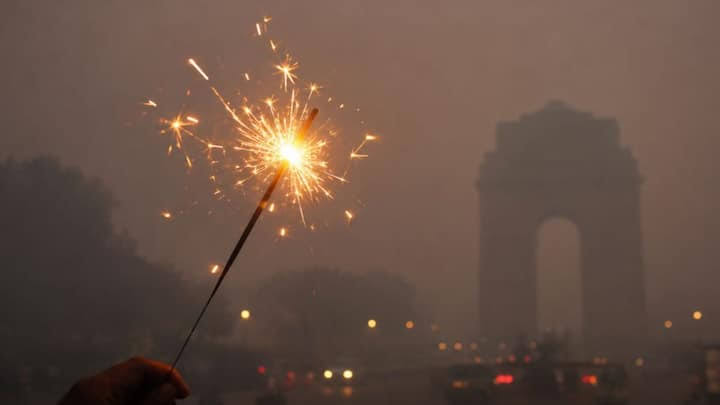
Delhi’s pollution reaches alarming levels after Diwali
According to CPCB data, Delhi recorded an average AQI of 376 on Diwali, November 8,
making it the most polluted Diwali in the capital in five years. The following morning,
the AQI remained around 370–371, with several monitoring stations reporting severe
pollution.
The pollution was not limited to one particular locality. Areas including Bawana, Burari,
Jahangirpuri, Sonia Vihar, Punjabi Bagh, Okhla and Rohini reported severe air quality
conditions.
A thick layer of smog reduced visibility on major roads and around prominent
landmarks, including India Gate. Residents complained of burning sensations in their
eyes, throat irritation, coughing and breathing difficulties.
How dangerous is an AQI above 400?
To understand the seriousness of the situation, India’s CPCB classifies air quality into
six categories:
•0–50: Good
•51–100: Satisfactory
•101–200: Moderate
•201–300: Poor
•301–400: Very Poor
•401–500: Severe
An AQI above 400 represents a serious public health concern. Prolonged exposure can
affect even healthy individuals, while children, elderly people and those suffering from
asthma, respiratory diseases and heart conditions face particularly high risks.
One of the biggest concerns is PM2.5, microscopic particulate matter that can
penetrate deep into the lungs and potentially enter the bloodstream. These particles
are released by firecrackers, vehicles, industrial activities and other combustion
sources.
The danger is not always immediately visible. Even when the sky appears slightly
clearer, harmful pollutants may continue to remain suspended in the atmosphere.
Firecrackers are not the only reason behind Delhi’s
pollution
Although firecrackers significantly contributed to the post-Diwali pollution spike,
blaming them alone would not explain Delhi’s recurring air quality crisis.
Several factors combine to make the situation worse during October and November:
- Firecracker emissions: Fireworks release fine particulate matter, sulphur
compounds and other pollutants, increasing pollution levels within a short period. - Stubble burning: Agricultural residue burning in Punjab and Haryana contributes
to the pollution load reaching the Delhi-NCR region. - Vehicle emissions: Millions of vehicles operating across the capital and
neighbouring cities release pollutants every day. - Construction dust: Road dust, construction activities and poorly managed
demolition work add to the particulate matter in the air. - Weather conditions: Low wind speeds, falling temperatures and stagnant
atmospheric conditions prevent pollutants from dispersing quickly.
The combination of these factors creates a dangerous pollution cocktail that becomes
particularly difficult to control during winter.
The Associated Press also reported that unfavourable weather conditions and multiple
pollution sources were contributing to the worsening situation across northern India.
What about Gurugram, Noida and other NCR cities?
The pollution crisis is not restricted to Delhi. Several neighbouring cities in Haryana
and Uttar Pradesh have also experienced unhealthy air quality following Diwali.
According to reports published on November 9, Charkhi Dadri in Haryana recorded an
AQI of 402, while Bahadurgarh recorded 397 and Rohtak reported 384. Bhiwani also
recorded an AQI of 358. These readings demonstrate that the pollution problem
extends well beyond the national capital.
For millions of people travelling between Delhi, Gurugram, Faridabad, Ghaziabad and
Noida every day, polluted air has become a shared public health concern.
GRAP restrictions and questions over government
action
Authorities had already implemented restrictions under the Graded Response Action
Plan (GRAP) to control worsening pollution across Delhi-NCR. These measures include
restrictions on certain construction activities, controls on polluting vehicles and
limitations on industrial operations.
However, despite restrictions on firecrackers and other pollution-control measures, the
post-Diwali situation has once again exposed the limitations of emergency responses.
The Supreme Court had permitted only certified low-polluting firecrackers during
specified hours, but widespread violations were reported during celebrations.
Questions have also emerged regarding air quality monitoring. Reports indicated that
several monitoring stations went offline during peak Diwali celebrations, creating
concerns about the completeness and reliability of pollution readings.
The government now faces the challenge of moving beyond temporary restrictions
and developing a long-term strategy to address pollution throughout the year.
What should people do to protect themselves?
•With pollution levels remaining dangerously high, residents are advised to take
precautions:
•Avoid outdoor exercise, jogging and morning walks when pollution levels are high.
•Wear a properly fitted N95 mask when travelling outdoors.
•Keep windows closed during periods of heavy pollution.
•Children and elderly people should minimise unnecessary outdoor exposure.
•People with asthma or heart conditions should follow their doctor’s advice and
•keep prescribed medication accessible.
•Avoid adding to pollution through waste burning and unnecessary vehicle use.
Conclusion: Is Delhi heading towards another pollution
emergency?
The post-Diwali pollution situation is another reminder that Delhi’s air quality crisis
cannot be solved through temporary restrictions alone. Every year, residents face the
same cycle of worsening air quality, emergency measures, political arguments and
promises of improvement.
Firecrackers may have intensified the problem this Diwali, but vehicle emissions,
industrial pollution, construction dust, agricultural burning and unfavourable weather
remain major contributors.
The real question is not whether Delhi’s AQI will improve after a few days of wind or
rainfall, but whether authorities can ensure that people breathe clean air throughout
the year.
For millions of residents, clean air should not be a seasonal luxury. It is a basic
necessity and a fundamental public health concern.
Hashtags:
DelhiPollution #DelhiAQI #PostDiwaliPollution #AirPollution #DelhiNCR #AQI400
SevereAQI #ToxicAir #DelhiSmog #Diwali2026 #AirQualityIndex #GurugramPollution
NoidaPollution #StubbleBurning #FirecrackerPollution #GRAP #CPCB #CleanAir
#EnvironmentalCrisis #HealthEmergency #SaveDelhi #PollutionCrisis